Building Art into a Building's Purpose
Author: Rosie Quasarano
Published: November 14, 2022
Read Time: 3 min
When plans for either a new build or renovation are discussed there are obvious questions to answer — How big will it be? What's the timeline? How much will it cost? Though maybe not the first question posed at a development meeting, one that carries as much (if not more) weight than the previous ones is simply — Who will this building inspire?
The buildings in which we live and work help form our identity and are a vital part of our daily lives. How, then, can developments transform from places that simply exist to sources of inspiration and connection?
Through art.
One shining example of this can be found in the Cesar Chavez Foundation (CCF) Housing & Economic Development Fund. Through this program, CCF aspires to be the catalyst that spurs investment in underserved communities and sets the bar for what can be achieved both individually and community-wide. Their developments inspire a sense of community and encourage people to serve others while also helping their own families prosper.
Beautify chatted with Paul Chavez, President of CCF, and son of the civil rights and farm labor leader, to learn more about the role art plays in living out their mission.
"When Cesar Chavez and the founders of the Farm Worker Movement began their work they understood that the arts would play a key role in informing, inspiring, and educating people. One of the things we've done with our housing program is look for ways to recognize people who have made important contributions. We started by naming our communities after people who should be remembered to both educate and uphold the legacy of folks."
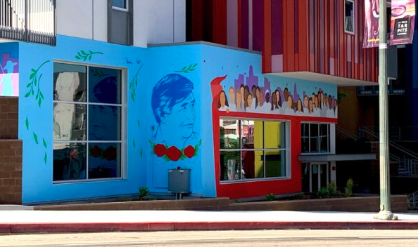
This powerful act inspired a push toward further recognizing change-makers by incorporating public art into the CCF housing program. It began with the project LA Plaza Village, where, in the early stages of development, artwork was discussed as an integral component of the build. From there a budget was established and a shortlist of artists, who could bring different points of view to the project, was created.
"L.A. has been a big part of the Farm Worker Movement in terms of support, but more than that the Latino community as a whole has tremendous ties to agriculture areas. In one of the LA Plaza murals, artist Barbara Carrasco depicted a march scene as well as the El Aliso tree. These images spanned generations yet bound people together to show the interconnectivity and history of Los Angeles with the Farm Worker Movement."
In total, LA Plaza Village features four public-facing murals created by Judithe Hernandez, Miguel Angel Reyes, Jose Lozano, and Barbara Carrasco that each uniquely celebrate the Mexican-American experience and truly connect with the community.
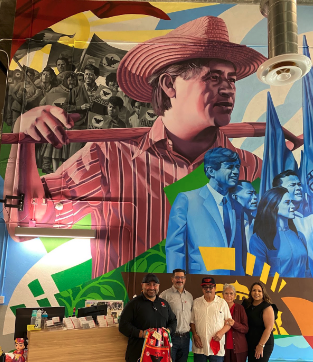
What began as showcasing public art in one development is now an integral part of the mission for CCF's housing program, as well as inside its own walls, too. The large-scale mural inside CCF, painted by artist John Park, draws attention from visitors who come to pose in front of it.
"We would like to put images up that can help strengthen and become a hallmark of our community. We've been blessed with people and communities honoring my father, and now it's our time to pay back and help tell the stories of the communities in which we're doing affordable housing."
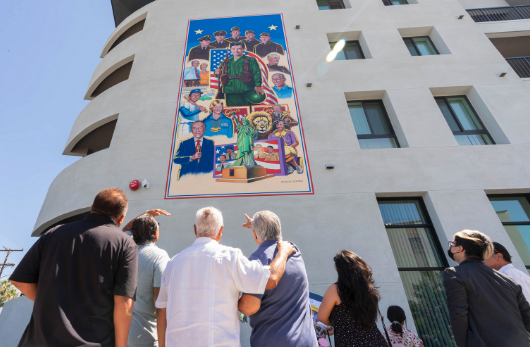
In the summer of 2022, CCF celebrated the grand opening of Plaza Ortiz, an affordable housing community for veterans and low-income residents, in El Monte, CA. The property was named in honor of 19-year-old El Monte native Ysabel "Mac" Ortiz who was killed during the Korean War. On one prominent wall of the property a mural conceived by artist Ignacio Gomez and painted by artist John Park honors Ortiz and other community heroes.
By integrating murals into their housing program the foundation that bears his name continues to honor Chavez's vision of using art as a vehicle to inform, inspire, and educate the world.
Interesting in inspiring your community through art? Contact us to bring your vision to life.
Tags
- Murals
- Community